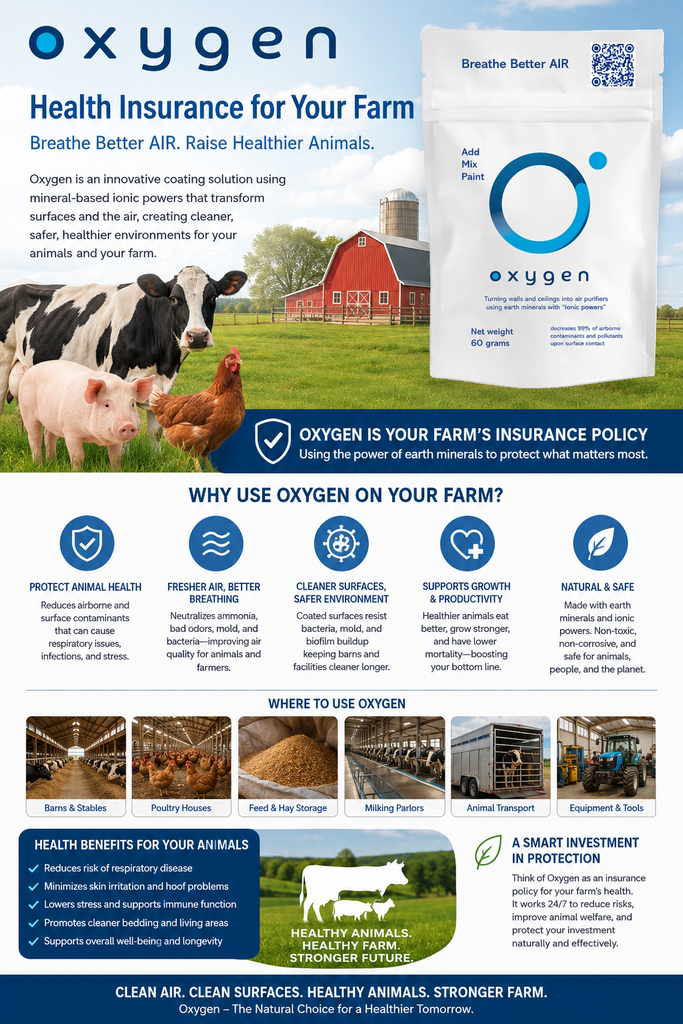

Oxygen for Farms: The Natural Health Insurance Policy for Livestock, Poultry, and Agricultural Facilities
Why Clean Air Matters More Than Ever on Modern Farms
Every farmer understands the importance of protecting animals from disease, stress, and environmental threats. While nutrition, water quality, and veterinary care receive significant attention, one critical factor is often overlooked: the quality of the air animals breathe every day.
Livestock, poultry, dairy cattle, horses, pigs, sheep, goats, and other farm animals spend countless hours inside barns, stables, feeding areas, milking parlors, transport trailers, and enclosed agricultural facilities. These environments can accumulate airborne contaminants, bacteria, mold spores, ammonia, dust, allergens, and unpleasant odors that may affect animal welfare and operational efficiency.
This is where Oxygen® offers a new approach.
Oxygen transforms ordinary walls and ceilings into passive air-purifying surfaces using earth minerals and ionic technology. When mixed into paint and applied throughout farm facilities, Oxygen creates an additional layer of environmental protection that continuously works around the clock.
Think of Oxygen as a natural health insurance policy for your farm.
What Is Oxygen?
Oxygen is a mineral-based additive designed to be mixed into interior paints and coatings.
Once applied to walls and ceilings, Oxygen creates active surfaces that help reduce airborne contaminants and pollutants that come into contact with treated surfaces.
Unlike air filtration systems that require electricity, maintenance, and replacement filters, Oxygen works passively 24/7 through the surfaces already present throughout a facility.
This allows barns, poultry houses, livestock shelters, feed storage areas, and animal care facilities to become part of the farm’s environmental management strategy.
The Hidden Air Quality Challenges Inside Farms
Many agricultural buildings face ongoing exposure to:
- Airborne bacteria
- Mold spores
- Mildew
- Dust particles
- Biofilm buildup
- Animal odors
- Ammonia gases
- Moisture-related contaminants
- Feed dust
- Organic waste particles
Over time, these environmental factors can create conditions that may contribute to:
- Respiratory irritation
- Increased stress among animals
- Reduced comfort
- Poor indoor air quality
- Surface contamination
- Odor management challenges
Creating cleaner environments can help support overall animal wellness and operational efficiency.
How Oxygen Supports Animal Health
1. Cleaner Air for Better Breathing
Animals depend on healthy respiratory systems for growth, performance, and overall wellbeing.
By reducing contaminants that come into contact with treated surfaces, Oxygen helps create cleaner indoor environments throughout:
- Dairy barns
- Poultry houses
- Pig barns
- Horse stables
- Sheep and goat facilities
- Veterinary buildings
- Animal transport units
Cleaner air environments may help reduce environmental stressors that affect breathing comfort.
2. Cleaner Surfaces Throughout the Facility
Barn walls, ceilings, feeding areas, and animal housing structures are constantly exposed to:
- Moisture
- Organic matter
- Dust accumulation
- Microbial contamination
Oxygen-treated surfaces help maintain cleaner environments by creating surfaces that actively work against contaminants.
This is particularly valuable in:
- Milking parlors
- Calving areas
- Poultry operations
- Feed processing rooms
- Veterinary treatment spaces
3. Odor Reduction and Fresher Facilities
One of the biggest challenges for livestock operations is odor control.
Common sources include:
- Ammonia
- Organic waste
- Moisture
- Feed decomposition
- Microbial activity
Oxygen helps create cleaner environments that contribute to fresher-smelling facilities for:
- Animals
- Farm workers
- Veterinarians
- Visitors
- Customers
A cleaner-smelling environment can improve the overall experience of working and spending time on the farm.
4. Supporting Animal Comfort and Reduced Stress
Research consistently shows that environmental quality influences animal welfare.
Animals thrive when they are raised in environments that are:
- Clean
- Comfortable
- Well ventilated
- Low stress
- Properly maintained
Cleaner surfaces and improved environmental conditions contribute to healthier living spaces that support animal wellbeing.
Best Places to Use Oxygen on Farms
Barns and Stables
Large wall and ceiling surfaces make barns ideal for Oxygen applications.
Benefits include:
- Cleaner air
- Cleaner surfaces
- Better environmental management
- Improved facility appearance
Poultry Houses
Poultry facilities can experience high levels of airborne particles and moisture.
Applying Oxygen throughout the facility helps create cleaner indoor environments where birds live and grow.
Feed and Hay Storage Areas
Feed quality is critical to animal health.
Oxygen can be applied in storage environments to support cleaner facility conditions where feed products are stored and handled.
Milking Parlors
Dairy operations require high standards of cleanliness.
Oxygen-treated surfaces can help support facility hygiene and environmental quality within milking areas.
Animal Transport Vehicles and Trailers
Transport environments can become stressful for animals.
Applying Oxygen to enclosed transport spaces helps create cleaner environments during movement between locations.
Why Oxygen Is Different from Traditional Solutions
Most environmental management solutions focus on:
- Filters
- Ventilation systems
- Chemical treatments
- Frequent cleaning protocols
While these remain important, Oxygen adds an additional layer of protection because it works continuously through the building surfaces themselves.
Oxygen Advantages
✅ No electricity required
✅ Works 24/7
✅ Easily mixed into paint
✅ Suitable for large surface areas
✅ Non-corrosive
✅ Mineral-based technology
✅ Can be applied during new construction or renovation
✅ Supports cleaner farm environments
The Economic Benefits for Farm Owners
Healthy environments support healthy operations.
Benefits may include:
- Better facility cleanliness
- Improved animal comfort
- Enhanced worker experience
- More professional-looking facilities
- Reduced odor concerns
- Stronger commitment to animal welfare
- Increased confidence from customers and visitors
For farms focused on productivity, sustainability, and animal care, investing in environmental quality can provide long-term operational value.
The Future of Healthier Farms
Agriculture is evolving.
Farmers today are looking beyond traditional disease prevention methods and adopting proactive environmental solutions that support animal welfare and sustainable operations.
Oxygen represents a new category of passive environmental protection—one that turns existing walls and ceilings into active contributors to cleaner farm environments.
By integrating Oxygen into barns, poultry houses, feed storage facilities, milking parlors, and animal care areas, farmers can create spaces designed with health, safety, and animal wellbeing in mind.
Final Thoughts
Healthy animals begin with healthy environments.
Oxygen helps transform farm facilities into cleaner, fresher, and more protective spaces by utilizing the power of earth minerals and ionic technology. Whether you operate a dairy farm, poultry facility, horse stable, livestock operation, or mixed agricultural enterprise, Oxygen offers a simple way to enhance environmental quality throughout your property.
Clean Air. Cleaner Surfaces. Healthier Animals. Stronger Farms.
Oxygen® – Turning Walls and Ceilings Into Air Purifiers.