THE WALLS ARE THE NEW AIR PURIFIERS
Why Healthy Buildings May Soon Be Designed Into the Materials Around Us
For decades, the building industry has largely asked one question when it comes to indoor air:
How do we move and clean the air?
HVAC systems. Ventilation. Filters. Air cleaners. Exhaust systems.
These technologies remain fundamental to indoor air quality—and they should.
But the conversation about healthy buildings is becoming much bigger.
Today, leading building-science organizations are asking us to think beyond temperature, energy consumption and mechanical systems and consider a more complete question:
How does the entire built environment affect the people who live, work, learn and sleep inside it?
That is the thinking behind ASHRAE President Bill McQuade’s 2025–26 theme:
“Healthy Buildings: Designing for Life.”
ASHRAE describes Indoor Environmental Quality as encompassing indoor air quality, thermal comfort, acoustics, lighting, water and energy efficiency—and emphasizes the relationship between these factors and human health and productivity.
This represents an important shift.
We are moving from designing buildings simply to operate efficiently toward designing buildings to support human well-being.
And that creates an extraordinary opportunity for innovation in one of the most overlooked components of a building:
The surfaces surrounding us.
WHAT IF THE BUILDING ITSELF COULD PARTICIPATE IN CLEANING THE ENVIRONMENT?
Think about the amount of surface area inside a typical building.
Walls.
Ceilings.
Corridors.
Classrooms.
Bedrooms.
Offices.
Hotel rooms.
Hospitals.
Retail spaces.
These surfaces are everywhere—but traditionally they have been passive.
They provide structure, aesthetics and protection.
What if some of those surfaces could also be engineered to perform an environmental function?
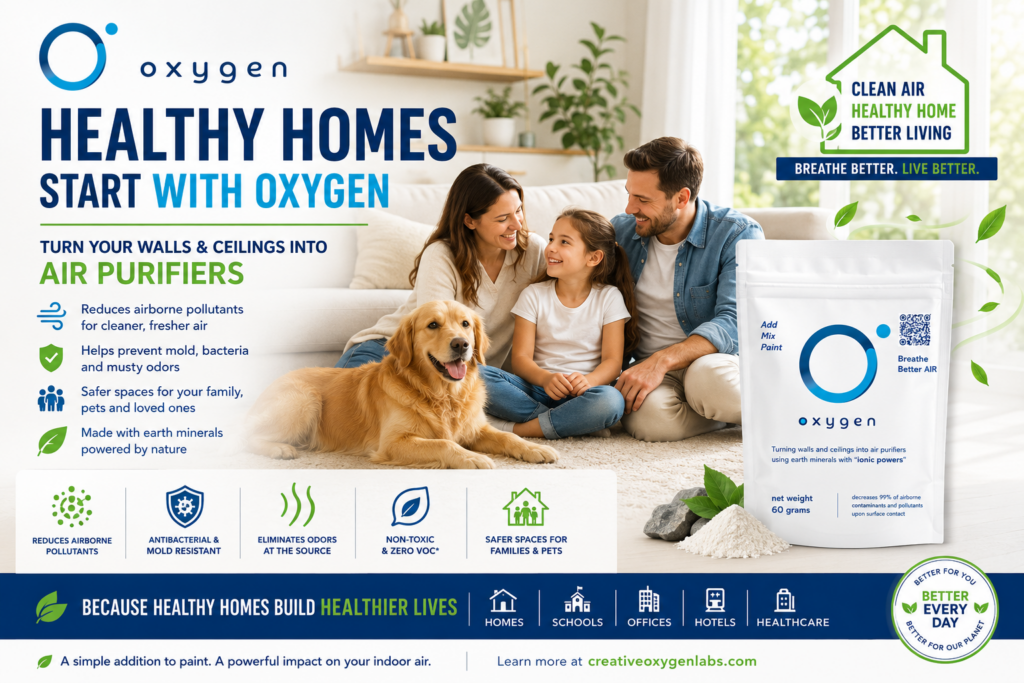
That is the concept behind Oxygen, developed by Creative Oxygen Labs.
Oxygen is a mineral-based paint additive designed to be mixed directly into acrylic or latex paint before application.
The objective is straightforward:
Turn an ordinary painted surface into a functional component of the indoor environment.
Rather than adding another appliance to a room, Oxygen introduces engineered mineral technology into a material that is already being applied to the walls and ceilings.
The philosophy is simple:
Don’t just clean the air moving through the building.
Look at the surfaces the air is constantly interacting with.
ASHRAE’S IAQ FRAMEWORK OPENS THE DOOR TO NEW MATERIAL TECHNOLOGIES
This is where the connection with ASHRAE becomes particularly interesting.
ASHRAE identifies three broadly accepted approaches to improving indoor air quality:
Source control.
Ventilation.
Air cleaning and contaminant removal.
Its guidance also recognizes that contaminants can originate from both indoor and outdoor sources and that effective IAQ strategies require an integrated approach.
ASHRAE’s current Standard 62.1-2025 incorporates requirements related to ventilation, filtration, air cleaning, controls, moisture and biological growth.
This is important because it establishes a fundamental principle:
Healthy indoor environments are created through layers of protection—not one single technology.
That is precisely where mineral-based functional coatings can potentially fit.
Oxygen isn’t intended to replace HVAC.
It isn’t intended to eliminate ventilation.
It isn’t intended to replace filtration.
Instead, the opportunity is to add another layer to the building’s environmental strategy.
FROM AIR-CLEANING MACHINES TO AIR-CLEANING MATERIALS
The conventional model is relatively simple:
Air enters a building.
The HVAC system moves it.
Filters capture certain contaminants.
Air cleaners may further treat it.
The air circulates.
But there is another way to think about the problem.
What if the materials inside the building could participate in contaminant management?
This is where earth-derived mineral science becomes particularly interesting.
Oxygen utilizes engineered mineral technology, including zinc oxide and silver-infused zirconium, incorporated into its paint additive.
The larger concept is not about creating another piece of equipment.
It is about distributing functional material across the enormous surface area already present inside the building.
A wall doesn’t require electricity.
A ceiling doesn’t require a motor.
A painted surface doesn’t need to be plugged into an outlet.
The potential advantage of this approach is architectural:
The technology becomes part of the building rather than something added to the building.
THE NEXT GENERATION OF HEALTHY BUILDINGS MAY BE MULTI-LAYERED
Imagine a healthy building as a series of protective layers.
Layer 1 — Source Control
Reduce the contaminants entering or being generated inside the building.
Layer 2 — Ventilation
Bring in appropriate outdoor air and remove contaminated indoor air.
Layer 3 — Filtration
Capture particulate contaminants through appropriately designed filtration systems.
Layer 4 — Air Cleaning
Use appropriate technologies to remove or transform selected contaminants.
Layer 5 — Moisture Management
Control the conditions that can contribute to dampness and biological growth.
Layer 6 — Functional Materials
Use carefully selected building materials and coatings that may contribute additional contaminant-management functions.
That final layer is where technologies such as Oxygen can begin to change the conversation.
THE WALL IS NO LONGER JUST A WALL
This may sound like a subtle change.
It isn’t.
For generations, we have treated building materials primarily as passive components.
Concrete holds the building together.
Glass lets light inside.
Insulation controls heat transfer.
Paint provides color and protection.
But technology is increasingly turning ordinary materials into functional materials.
Windows can generate electricity.
Concrete can incorporate sensors.
Glass can dynamically control solar gain.
Building systems can respond intelligently to occupancy.
And now, coatings can be engineered with mineral technologies designed to interact with the indoor environment.
The question is no longer simply:
“What color should this room be?”
The question becomes:
“What should this room do for the people inside it?”
HEALTHY BUILDINGS REQUIRE A CHANGE IN MINDSET
ASHRAE’s current healthy-building initiative recognizes that indoor environmental quality affects health, comfort, well-being and productivity. Its resources are designed to help building owners, occupants and policymakers understand these interconnected factors.
That creates an opportunity for the building-material industry.
Paint manufacturers.
Architects.
Interior designers.
HVAC engineers.
Facility managers.
Contractors.
Developers.
Property owners.
They all have a role to play.
The future of healthy buildings shouldn’t belong to HVAC alone.
It shouldn’t belong to architects alone.
It shouldn’t belong to environmental engineers alone.
It should belong to everyone who touches the building.
FROM GREEN BUILDINGS TO HEALTHY BUILDINGS
The green-building movement taught the world to think about energy.
The sustainability movement expanded the conversation toward carbon, water, materials and resources.
The healthy-building movement takes the next step:
People.
A building can be energy efficient and still have poor indoor air quality.
A building can have impressive sustainability credentials and still contain environments that occupants don’t experience as healthy.
A building can be technologically advanced and still overlook the everyday surfaces surrounding its occupants.
That’s why the next generation of building innovation needs to bring health and sustainability together.
ASHRAE’s own messaging captures this relationship: energy efficiency and good IEQ need to work together so buildings can be environmentally sustainable while supporting occupant health and productivity.
OXYGEN’S BIGGER IDEA
Oxygen isn’t simply about selling a pouch of powder to mix into paint.
The bigger idea is changing the way we think about the building itself.
What if every renovation became an opportunity to improve the indoor environment?
A painter isn’t simply applying color.
They could be helping create a healthier interior.
A property manager isn’t simply maintaining walls.
They could be upgrading the building’s environmental performance.
An interior designer isn’t simply selecting finishes.
They could be selecting materials with human health in mind.
A building owner isn’t simply investing in aesthetics.
They could be investing in occupant experience.
And the homeowner isn’t simply repainting a bedroom.
They could be thinking about the environment their family breathes every day.
THE FUTURE OF AIR QUALITY MAY BE EVERYWHERE
The most exciting possibility is that healthy-building technology will not be concentrated in one location.
It will be distributed.
In the HVAC system.
In the filtration system.
In sensors.
In ventilation controls.
In building materials.
In coatings.
In furnishings.
And potentially, across the very surfaces surrounding us.
That’s the future Oxygen is working toward.
Not replacing the systems that already make buildings healthier.
Adding another layer.
Not asking people to install another machine.
Making an existing building material perform a new function.
Not treating walls as passive backgrounds.
Reimagining them as part of the indoor environmental ecosystem.
THE BIGGER QUESTION
ASHRAE is challenging the building industry to think about what it means to truly design buildings for life.
Oxygen is asking a complementary question:
If we are going to design buildings for human health, shouldn’t we also rethink the materials we put inside them?
The future healthy building may not be defined by one revolutionary machine.
It may be defined by hundreds of small innovations working together.
Better ventilation.
Better filtration.
Better moisture management.
Better materials.
Better monitoring.
Better design.
And potentially, better surfaces.
Because the next generation of buildings shouldn’t just shelter people.
They should actively support the environments in which people live, work, learn and breathe.
Oxygen believes the walls can be part of that future.