Reduce Risk Before It Becomes a Claim: Why Insurance Agents Should Look Beyond Insurance and Toward Healthier Buildings

Insurance Is About Risk Reduction. The Next Opportunity Is Prevention.
Insurance has traditionally been there when something goes wrong. A pipe leaks. Mold develops. A building is damaged. Employees or tenants complain about indoor conditions. A property owner files a claim.
But what if insurance professionals could become part of the conversation before the problem becomes a claim?
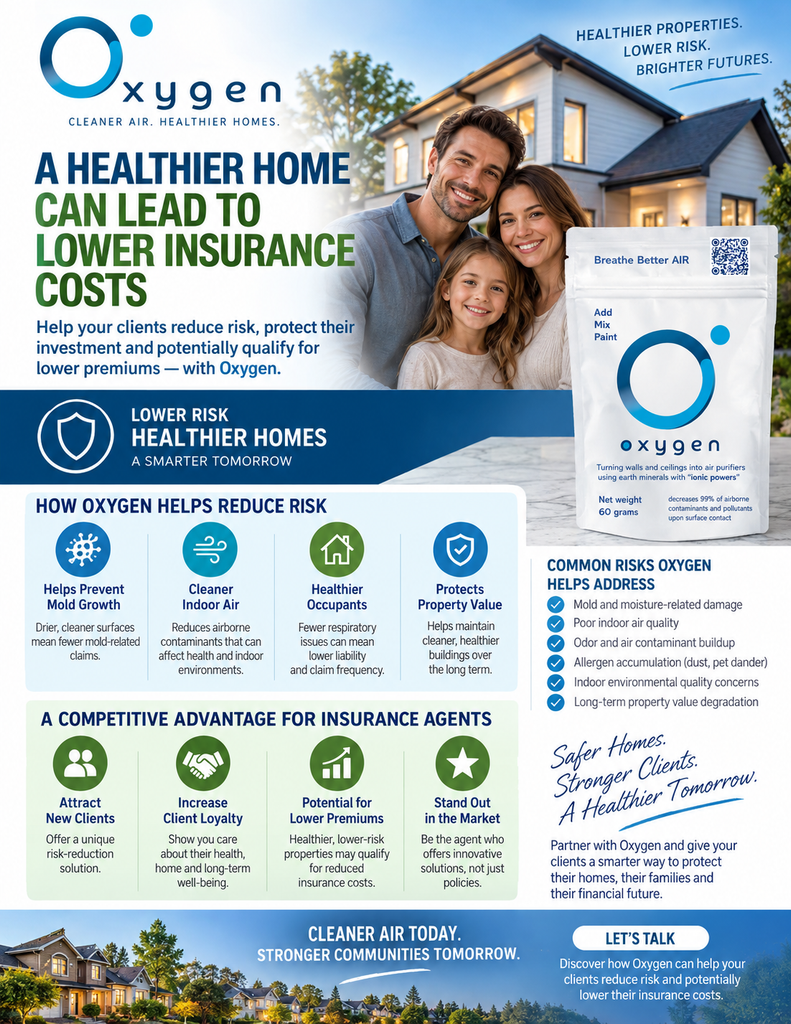
That is the opportunity behind Oxygen Paint Additive.
Oxygen is designed to transform conventional interior paint into functional paint by adding a blend of earth-mineral technology to the paint before application. Instead of viewing walls and ceilings simply as decorative surfaces, Oxygen’s concept is to make those enormous surface areas an active part of a broader strategy for maintaining healthier indoor environments.
For insurance agents serving homeowners, landlords, condominium owners and businesses, this creates a powerful new conversation:
INSURE + PREVENT + PROTECT
The objective isn’t to replace insurance. It’s to complement it with prevention.
What Is Sick Building Syndrome?
The U.S. Environmental Protection Agency describes Sick Building Syndrome (SBS) as a situation in which building occupants experience symptoms associated with time spent inside a particular building, while no specific illness or single cause can necessarily be identified. Symptoms can include headaches, fatigue, dizziness and irritation of the eyes, nose or throat.
That distinction matters.
A building doesn’t have to look unhealthy to have indoor environmental problems.
Moisture, inadequate ventilation, airborne particles, biological contaminants, odors, volatile organic compounds and other pollutants can all contribute to poor indoor environmental quality.
EPA recommends three fundamental approaches to improving indoor air quality: source control, improved ventilation, and air cleaning/filtration.
Functional surfaces can potentially become another layer within a comprehensive building-management strategy—but they should complement, not replace, those fundamentals.
Mold Is Both a Building Problem and a Health Concern
For insurance professionals, mold deserves particular attention because it sits at the intersection of property condition, moisture management and occupant health.
CDC states that mold grows where moisture is present, including around leaking roofs, windows and pipes and following flooding. Mold can also grow on drywall, insulation, ceiling tiles, wood, wallpaper, carpet and even paint.
NIOSH reports that prolonged dampness can allow mold to multiply on building materials and that people in damp buildings can be exposed to spores, fungal fragments, microbes and other substances. Damp buildings have been associated with respiratory symptoms and infections, worsening or development of asthma, allergic rhinitis and other health problems.
This is exactly why prevention matters.
Once substantial mold contamination exists, painting over it is not the solution. The moisture source must be found and corrected and existing mold appropriately remediated. CDC specifically emphasizes correcting dampness as an essential preventive measure.
Oxygen should therefore be positioned as part of a preventive strategy for properly prepared, dry surfaces—not as a substitute for repairing leaks, moisture control or mold remediation.
From Ordinary Paint to Functional Paint
Virtually every residential and commercial property eventually gets painted.
The question is:
Why use paint only for color when the painted surface could provide additional functionality?
Oxygen Paint Additive is mixed into compatible conventional paint before application. Its earth-mineral technology is intended to give the finished painted surface additional functional properties.
Based on third party laboratory testing in Canada and the United States, Oxygens earth mineral technology has demonstrated antibacterial activity and resistance to mold growth under specified test conditions. Those results provide an important basis for investigating Oxygen as a preventive surface technology.
The insurance proposition becomes especially interesting because this doesn’t require introducing an entirely new building system.
Six Reasons Insurance Agents Should Introduce Oxygen
1. Reduce risk before it becomes a claim. Rather than limiting the insurance conversation to what happens after damage occurs, agents can encourage clients to think proactively about indoor environmental conditions, moisture management, building maintenance and healthier surfaces.
2. Support mold-prevention strategies. Oxygen-treated paint can be incorporated into a larger mold-management program alongside moisture control, leak repair, ventilation and appropriate remediation. That is particularly relevant for bathrooms, basements, rental properties, offices and other moisture-prone environments.
3. Support healthier indoor environments. Indoor environmental quality increasingly matters to homeowners, employees, tenants, parents, property managers and building owners. Introducing functional paint gives agents something tangible to discuss beyond deductibles and policy limits.
4. Move insurance from reactive to proactive. An agent who says, “I want to help protect your property before you ever need to call me about a claim,” creates a fundamentally different customer relationship.
5. Differentiate the insurance agency. Price comparison has commoditized much of insurance. Prevention programs give agents another way to create value, strengthen retention and begin conversations with new commercial prospects.
6. Build evidence for future insurance programs. This could ultimately be the biggest opportunity. Insurers could pilot Oxygen-treated properties and compare relevant loss experience with comparable untreated properties. If credible data eventually demonstrate lower claim frequency or severity, insurers would have evidence upon which to evaluate incentives or underwriting programs.
That last step requires real insurance loss data; premium reductions should not be promised today unless an individual insurer has specifically approved them.
Why Big Cities Make This Conversation Even More Important
Urban buildings operate in challenging environments.
Traffic, combustion, construction, industrial activity and dense development contribute to outdoor pollution that can interact with indoor environments. WHO identifies particulate matter, nitrogen dioxide, ozone, carbon monoxide and sulfur dioxide among pollutants of major public-health concern.
Toronto offers a useful example. The City identifies traffic-related air pollution as its largest local source of air pollution, followed by industrial and residential sources.
Think about the implications for cities such as Toronto, New York, Los Angeles, Chicago, London, Paris, Mexico City, Mumbai or São Paulo.
Millions of people spend substantial portions of their lives inside apartments, offices, schools, clinics, hotels, restaurants and other enclosed spaces.
Outdoor pollution can enter buildings, while indoor sources add another layer of contaminants.
This creates an enormous opportunity for healthier-building technologies.
Oxygen’s earth-mineral approach is particularly interesting because walls and ceilings represent some of the largest surfaces inside virtually every building.
Instead of asking:
“How can we put another machine in the room?”
Oxygen asks:
“What if the surfaces already surrounding us could become functional?”
That is a compelling clean-building concept.
A New Commercial Insurance Conversation
Consider an insurance agent meeting the owner of a 50,000-square-foot office building.
The traditional conversation revolves around:
property insurance, liability, deductibles, replacement costs, business interruption and premiums.
Now add another conversation:
How are you reducing environmental risks inside the building?
That can open discussions about water intrusion, mold prevention, HVAC maintenance, ventilation, indoor environmental quality, surface maintenance and healthier renovation practices.
Oxygen gives the agent a physical product connected to that prevention conversation.
The same concept can apply to:
apartments and condominiums, offices, daycares, schools, senior residences, hotels, restaurants, gyms, medical and dental clinics, retail stores and residential homes.
Insurance Agents Can Become Risk-Reduction Partners
Imagine an agency introducing a Healthy Property Program during annual insurance reviews.
The conversation isn’t:
“Buy Oxygen and your premium will decrease.”
It is:
“We insure your property, but we also want to help you identify practical ways to reduce preventable risks before they become losses.”
That is much stronger.
The program could encourage customers to inspect for water intrusion, control humidity, maintain HVAC systems, improve ventilation, remediate existing mold and consider functional coatings such as Oxygen when repainting.
The insurer or brokerage could then document participating properties.
Over several years, the data could answer the question that ultimately matters to insurers:
Did participating properties experience fewer or less severe relevant claims?
If the answer eventually proves to be yes, Oxygen moves from an interesting building innovation toward a potentially measurable insurance risk-management tool.
The Future of Paint May Be Functional
For decades, consumers selected paint primarily around three considerations:
Color. Finish. Price.
The next generation of coatings can add another consideration:
FUNCTION.
Buildings are where people live, sleep, work, learn, recover, exercise and raise their families.
Walls and ceilings surround them every day.
Oxygen’s proposition is simple: when those surfaces need painting anyway, why not explore adding functionality to them?
For insurance professionals, that leads to an equally simple proposition:
Don’t Just Insure Risk. Help Reduce It.
Oxygen should not be presented as a cure for Sick Building Syndrome, a replacement for ventilation, a solution for existing water damage, or a guarantee against insurance claims.
It can instead be positioned as one component of a broader healthier-building and preventive property-management strategy.
And that may be precisely where insurance is heading: away from a relationship that begins when something goes wrong and toward one that helps customers prevent problems in the first place.
OXYGEN
INSURE + PREVENT + PROTECT
Cleaner Air. Healthier Buildings. Lower Risk.
Because the best claim may ultimately be the one that never has to be made.