

The Walls Around Us Matter: Why Functional Surfaces Belong in the Holistic Health Conversation
Dr. Susan Myers: An educational perspective for naturopathic and integrative healthcare practitioners
As a naturopathic doctor, I am trained to look beyond symptoms and consider the environment in which health, or dysfunction, develops. We talk with patients about nutrition, sleep, stress, movement, hydration, supplementation and toxic exposures. Yet there is another part of the health equation that deserves considerably more attention: the indoor environment surrounding us for thousands of hours every year.
We breathe continuously. We sleep surrounded by walls. We work beside them. Our children play between them.
This raises an intriguing question for preventative medicine:
What if the walls surrounding us could do more than simply hold color?
That is why functional surface technologies such as Oxygen paint additive deserve consideration within the broader environmental-health conversation.
From Passive Walls to Functional Surfaces
Conventional interior paint is essentially passive. Once dry, its primary functions are aesthetic and protective.
Oxygen proposes something different.
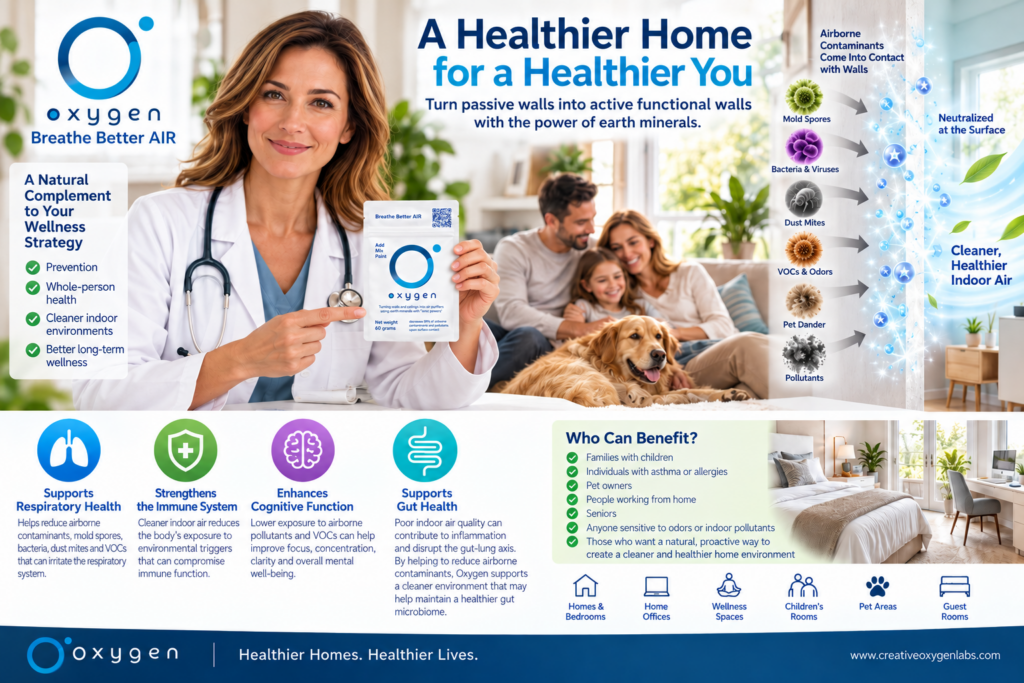
The 60-gram Oxygen pouch contains functional earth-mineral technology designed to be incorporated into compatible paint. Once mixed and applied, these minerals become distributed throughout the coating, transforming a large painted surface into what can be described as an active functional wall with IONIC powers.
This distinction matters.
A typical bedroom, home office or living space contains substantial wall and ceiling surface area. Instead of treating those surfaces merely as decoration, functional coatings offer the possibility of making the building envelope itself part of an environmental wellness strategy.
The concept is remarkably simple:
Add. Mix. Paint.
The resulting coating is intended to continue functioning passively in the background, with Oxygen positioning its functionality as lasting for up to 10 years.
Understanding the Ionic Mineral Concept
Oxygen’s technology incorporates functional minerals including zinc oxide and silver-containing mineral technology.
These materials are interesting because their surface chemistry has been extensively investigated scientifically. Zinc oxide, particularly at very small particle sizes, can exhibit photocatalytic and antimicrobial activity. Silver ions are also well known for antimicrobial activity and have been incorporated into numerous materials and surface technologies.
When properly incorporated into a coating, these minerals don’t need to be thought of as something being delivered into the human body. That would be the wrong biological model.
Their potential health value is instead environmental.
The functional surface is designed to interact with certain contaminants when they encounter the treated wall. The objective is therefore to reduce environmental contaminant burden at the surface rather than administer a therapeutic substance to a patient.
That distinction is particularly important for healthcare practitioners.
Why Surface Area Matters
Imagine covering one small object with functional material. Its environmental influence is inherently limited by its surface area.
Now imagine applying functional technology across hundreds of square feet of walls and ceilings.
Suddenly the surface available for interaction becomes dramatically larger.
This is what I find compelling about the functional-wall concept. Architecture itself becomes part of the environmental strategy.
Air movement generated by heating and cooling systems, doors opening, people walking through rooms and natural convection continually moves air through indoor spaces. Airborne material may eventually encounter walls, ceilings and other surfaces.
Oxygen is designed so that when susceptible contaminants reach the treated surface, the functional mineral chemistry can interact with them.
The wall is no longer simply there.
It has a purpose.
Indoor Environment and Respiratory Health
From a naturopathic perspective, reducing unnecessary environmental exposure is consistent with preventative medicine.
Indoor environments can contain particulate matter, mold spores, allergens, volatile organic compounds, odors and biological contaminants. Their concentrations and health significance vary substantially between buildings and individuals.
For someone experiencing respiratory sensitivity, addressing the environment should never be reduced to one intervention. Moisture problems must be corrected. Active mold contamination requires appropriate remediation. Ventilation matters. Filtration matters. Smoking and combustion sources matter.
Functional surfaces can potentially become another layer within that strategy.
This is how I believe Oxygen should be viewed, not as a replacement for ventilation, filtration, medical treatment or remediation, but as a complementary environmental technology.
The Immune System: Think Exposure, Not Stimulation
We also need to be precise when discussing immunity.
I would not describe a functional paint coating as something that directly “boosts” or “strengthens” a person’s immune system. Human immunity is far more sophisticated than that.
The more scientifically responsible question is:
Can we create an indoor environment that reduces unnecessary exposure to certain biological and environmental stressors?
If a surface technology reduces viable bacteria or inhibits certain mold growth under validated conditions, its contribution is environmental rather than pharmacological.
That principle aligns well with naturopathic medicine.
Preventative medicine isn’t exclusively about giving the body something. Sometimes it means removing or reducing what the body continually encounters.
Cognitive Health and Indoor Air Quality
The brain should also be part of the indoor environmental discussion.
Research has increasingly examined relationships between ventilation, carbon dioxide, particulate pollution, VOC exposure and aspects of cognitive performance. This does not mean a functional wall coating can be said to improve memory, concentration or intelligence directly.
It means that indoor environmental quality matters to human performance.
For patients working eight hours per day from home, children studying in bedrooms, seniors spending significant time indoors or families living in densely populated urban environments, improving the indoor environment is a reasonable component of a broader wellness strategy.
Functional walls therefore become especially interesting in bedrooms, children’s rooms, home offices, living areas and wellness spaces.
What About Gut Health?
The gut microbiome has become central to modern discussions of integrative medicine, but we should be careful not to overextend the science.
There is fascinating research concerning interactions between environmental exposures, inflammation, immunity and the microbiome. However, we should not claim that applying Oxygen to a wall directly “improves gut health” without clinical evidence demonstrating that outcome.
The better holistic principle is broader:
Human health does not exist independently of the environment.
Our respiratory system, immune system, gastrointestinal system, nervous system, skin and microbiome form an interconnected biological ecosystem. Environmental medicine therefore asks us to consider what people breathe, ingest, touch and encounter over time.
That philosophy fits naturally within naturopathic practice.
Why Naturopathic Doctors Should Pay Attention
Naturopathic medicine has historically been willing to examine health beyond the conventional boundaries of the doctor’s office.
We ask about food.
We ask about sleep.
We ask about stress.
We ask about exercise.
We ask about supplements.
Increasingly, we should also be asking about the patient’s home.
Does the bedroom have moisture problems? Is ventilation adequate? Are there persistent odors? Is there visible mold? Are pets contributing significant allergens? Does the patient work all day in a poorly ventilated room? Are indoor pollutant sources being controlled?
And when the patient is renovating or repainting anyway, we can ask another question:
Could those newly painted walls be made functional?
This is where a product such as Oxygen becomes particularly relevant.
A New Category: Environmental Wellness Through Functional Paint
The opportunity here is larger than one paint additive.
We are witnessing the emergence of functional building materials, materials designed to do more than provide structural or aesthetic value.
For naturopathic medicine, that represents an exciting extension of preventative thinking.
Rather than waiting for environmental exposures to contribute to problems and then focusing entirely on the individual, we can also improve the environment surrounding the individual.
That is prevention upstream.
Oxygen takes something every home already has, walls and ceilings, and asks them to perform another job.
The technology works quietly in the background. There is no filter for the homeowner to replace and no machine that must be switched on for the coating itself to function. Once incorporated into the appropriate paint and applied, the functional minerals remain within the coating.
That simplicity could make functional surfaces particularly attractive within holistic home design.
An Important Standard for Practitioners
Healthcare professionals should still demand evidence.
Before recommending any environmental technology, I would want to understand its laboratory testing, test methods, coating compatibility, durability, exposure characteristics and the precise claims supported by those results.
Claims concerning bacteria, mold, VOCs, allergens, pollutants and duration should each be tied to appropriate evidence rather than extrapolated from the known properties of individual ingredients.
That scientific discipline strengthens the holistic-health argument rather than weakening it.
Naturopathic medicine should be open to innovation, but openness and evidence should travel together.
The Home as Part of Preventative Medicine
Perhaps the most important shift is philosophical.
We have spent decades thinking about walls as passive boundaries.
Functional materials challenge that assumption.
A bedroom wall can still provide color and beauty while potentially serving another environmental purpose. A home office can contain hundreds of square feet of functional surface. A child’s room can be designed not simply around aesthetics, but around environmental quality.
For practitioners committed to whole-person medicine, this deserves attention.
Healthy living is not determined solely by what we put into our bodies. It is also influenced by the environments in which our bodies spend their lives.
That is why I believe technologies such as Oxygen warrant serious discussion within naturopathic and integrative healthcare.
Not as medicine.
Not as a cure.
Not as a substitute for appropriate medical care, ventilation, filtration or environmental remediation.
But as something potentially very useful within the preventative-health toolbox:
A way of turning passive walls into functional surfaces with purpose.
And perhaps that is where the next chapter of holistic environmental health begins, not only with healthier people, but with healthier spaces surrounding them.