Hyperbaric Oxygen Therapy vs. Oxygen-Infused Paint: Why Healthier Living Starts With Your Walls
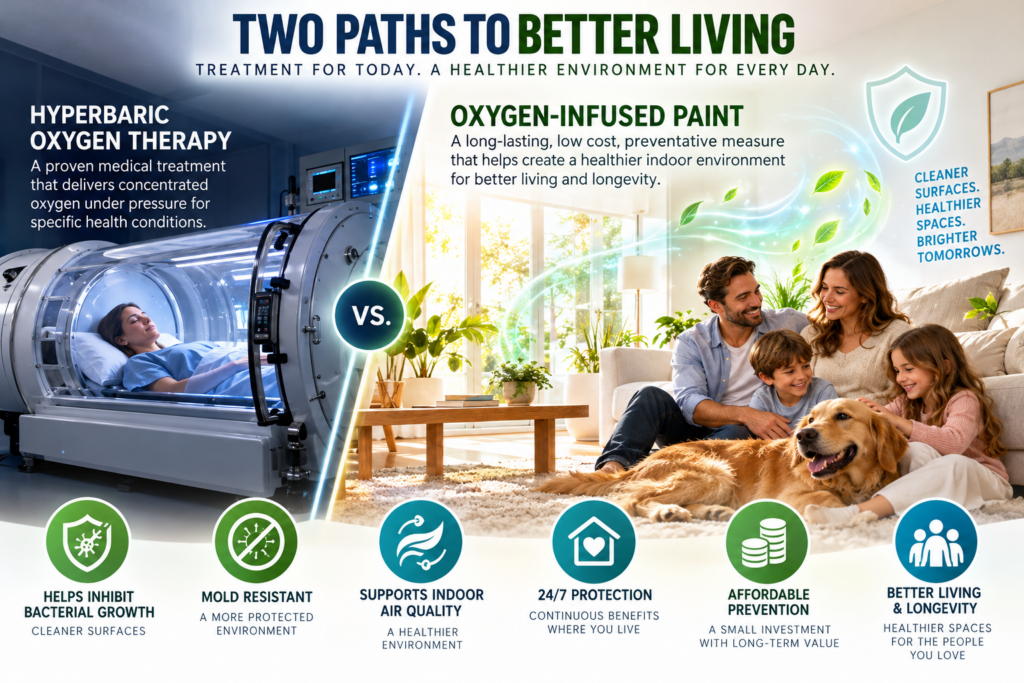
A smarter approach to healthier indoor spaces, long-term wellness and affordable prevention.
What if improving your indoor environment didn’t require expensive equipment, daily appointments or a major home renovation? What if part of the solution was already on your walls?
We spend approximately 90% of our time indoors, surrounded by walls, ceilings, furniture and surfaces that influence the quality of our living environment.
Yet when discussing health and longevity, we often focus on what we eat, how much we exercise and which treatments might improve our well-being. We pay considerably less attention to the air we breathe throughout the day and night.
Two very different innovations illustrate an important distinction: Hyperbaric Oxygen Therapy (HBOT) and Oxygen-infused paint powered by earth-derived minerals.
One is designed to deliver oxygen to the body under medical supervision. The other is designed to make indoor surfaces more functional, helping address environmental contamination where people spend their lives.
Both have their place. But for everyday living, prevention deserves far more attention.
Hyperbaric Oxygen Therapy: Treating the Individual
Hyperbaric Oxygen Therapy involves breathing oxygen inside a specially pressurized chamber.
The increased atmospheric pressure allows more oxygen to dissolve into the bloodstream, supporting tissue oxygenation and healing in certain medical conditions.
HBOT is an established treatment for selected conditions, including decompression sickness, carbon monoxide poisoning and some difficult-to-heal wounds.
However, it is not a general-purpose solution to poor indoor air quality.
A typical session lasts approximately 60–120 minutes, and some treatment plans require multiple visits.
Private treatment can also be expensive, depending on the clinic, location and medical indication.
Most importantly, when someone returns home from a hyperbaric chamber, the indoor environment they return to remains unchanged.
If their home has moisture problems, mold contamination, chemical emissions or inadequate ventilation, HBOT does not eliminate those environmental hazards.
That raises a practical question: Rather than focusing exclusively on treatments, shouldn’t we also invest in making our everyday environments healthier?
Oxygen-Infused Paint: Turning Passive Walls Into Functional Surfaces
Developed by Creative Oxygen Labs, Oxygen is a mineral-based paint additive designed to give ordinary painted surfaces additional protective properties.
Its formulation incorporates earth-derived minerals, including zinc oxide and silver-based compounds, selected for their antimicrobial properties and potential environmental applications.
Instead of purchasing specialized paint, consumers add a small 60-gram Oxygen pouch to a gallon of compatible paint, mix and apply.
Add. Mix. Paint.
The result is a functional coating designed to help inhibit microbial growth on treated surfaces and support a cleaner indoor environment.
The technology builds on established research into zinc oxide, silver-based antimicrobial materials and photocatalytic coatings.
Creative Oxygen Labs reports laboratory testing demonstrating antibacterial activity and resistance to mold growth under specified test conditions.
These findings are promising, although surface antimicrobial testing is not the same as demonstrating reduced airborne contamination or improved human health. Those outcomes require additional real-world testing.
The appeal is straightforward: Rather than introducing another machine into the home, Oxygen incorporates functional materials into surfaces that already exist.
The Comparison: Medical Treatment vs. Everyday Environmental Protection
| Feature | Hyperbaric Oxygen Therapy | Oxygen-Infused Paint |
| Primary objective | Increase oxygen delivery to body tissues | Improve the functional properties of indoor surfaces and spaces |
| Application | Medical treatment session | Added to ordinary paint |
| Duration | Typically 60–120 minutes per session | Coating remains in place continuously |
| Antimicrobial properties | Not a building-surface treatment | Laboratory-supported activity on treated surfaces |
| Mold prevention | Does not prevent building mold | Can inhibit mold growth on treated coatings and surfaces |
| Indoor pollution | Does not remove household pollutants | Pollutant-reduction through ionic reaction |
| Number of users | Individual patient | Shared indoor environment |
| Typical expense | Potentially hundreds of dollars per private session | $40 retail per pouch, excluding paint and labor |
| Long-term value | Depends on medical indication and treatment outcome | Potential long-term environmental value with limited additional upkeep |
The key difference: Hyperbaric therapy is intended to address specific medical needs. Oxygen-infused paint is designed to address environmental conditions before they become larger maintenance and exposure concerns.
They are complementary concepts, not interchangeable medical interventions.
Why 24/7 Protection Matters
Imagine a family of four living in a home with untreated walls.
Throughout the day, they cook, clean, sleep, work, entertain guests and spend time with their pets.
Every activity influences their indoor environment.
Now imagine incorporating mineral-based functional coatings into the walls of that same home.
Unlike a device that must be switched on or a therapy that requires an appointment, those treated surfaces remain present around the clock.
That is the fundamental advantage of passive environmental technology.
Oxygen’s intended long-term benefits include:
- Surface hygiene: Helping inhibit the growth of certain bacteria on treated surfaces.
- Mold resistance: Providing an additional protective measure against mold growth on the coating.
- Potential pollutant management: Using mineral-based chemistry with applications in photocatalytic pollutant reduction.
- Convenience: Incorporating protective functionality into an ordinary painting project.
- Shared benefit: Treating the physical environment rather than providing a service to one individual.
However, continuous presence should not be confused with guaranteed continuous air purification. Actual performance depends on the formulation, lighting, airflow, humidity and other environmental conditions.
And no antimicrobial paint replaces ventilation, filtration, moisture control or professional mold remediation when required.
The Economics of Prevention: A Small Investment With Long-Term Potential
One of Oxygen’s strongest advantages is affordability.
A single 60-gram pouch retails for approximately $40 and is designed to mix with one gallon of compatible paint, covering roughly 300–400 square feet.
Consider a simple illustration:
| Example expenditure | Estimated cost |
| One Oxygen pouch | $40 |
| Three Oxygen pouches | $120 |
| Ten Oxygen pouches | $400 |
| One private HBOT session | $150–$300* |
| Thirty private HBOT sessions | $4,500–$9,000* |
HBOT costs are illustrative and vary by provider and location. Medically indicated treatment may be covered by insurance or public healthcare. Oxygen costs exclude paint and application.
These figures do not compare equivalent medical outcomes. They demonstrate how differently the two approaches are delivered and financed.
For a homeowner already planning to repaint, Oxygen represents a relatively modest additional materials expense.
If the coating maintains its intended properties over an extended service life, the cost can be spread across years of occupancy.
For example, a $40 pouch used in a coating lasting ten years represents just $4 per year in additive cost, excluding other expenses.
That is an illustrative cost calculation, not proof that antimicrobial or pollutant-reduction performance remains unchanged for ten years. Long-term efficacy must be validated through durability and aging studies.
Nevertheless, the economics are compelling for homeowners looking to incorporate additional environmental protection into renovations they already intend to undertake.
Healthy Homes, Healthy Living: The Connection to Longevity
Longevity is about more than extending lifespan. It is also about preserving quality of life.
Respiratory health, sleep quality, cognitive performance and overall wellness can all be affected by environmental conditions.
The World Health Organization and environmental health agencies have long recognized indoor air pollution, dampness and mold as important public health concerns.
Poor indoor environmental quality can contribute to respiratory irritation, allergic symptoms and other health problems.
This is why prevention matters.
A healthier indoor environment generally involves several complementary strategies: controlling moisture, removing pollution sources, providing adequate ventilation, using appropriate filtration and selecting building materials that minimize unnecessary exposure.
Functional coatings such as Oxygen may offer another layer of protection within that broader strategy.
The potential is particularly relevant for homes with children, older adults, pets and people who spend extended periods indoors, as well as daycares, senior living facilities, offices and hospitality properties.
Importantly, the evidence does not yet establish that Oxygen-infused paint directly increases lifespan, improves immune function or prevents illness. Its most defensible contribution to longevity is as a potential component of healthier building design.
Why Wait Until There Is a Problem?
We maintain our vehicles before they break down.
We replace filters before equipment fails.
We invest in healthier food, regular exercise and preventive healthcare because addressing risks early often makes sense.
Our homes deserve similar attention.
For decades, paint has primarily been selected for its color, finish, durability and price.
But material science is expanding what a painted surface can do.
Earth-derived minerals such as zinc oxide and silver-containing compounds offer possibilities beyond decoration, including antimicrobial surface functionality.
Oxygen brings that approach into a simple consumer-friendly format.
It is not a substitute for medicine, nor is it a cure for unhealthy buildings.
It is an opportunity to rethink ordinary surfaces as part of a more proactive indoor environmental strategy.
The Future of Wellness Is Not Just What We Do to Our Bodies. It’s Where We Live.
Hyperbaric Oxygen Therapy has an important role in medicine, and its proven applications should be respected.
But creating healthier homes requires a different mindset.
It requires solutions that are practical, affordable, scalable and compatible with everyday life.
Oxygen-infused paint represents one approach: bringing mineral-based functionality into walls and ceilings, without requiring homeowners to adopt complicated new routines.
The most powerful idea is not that painted walls can replace medical treatment. It’s that healthier living begins by improving the environments we occupy every day.
For a modest incremental investment during painting, homeowners can introduce functional surface technology designed to provide additional protection over time.
As real-world testing continues to establish its environmental performance and durability, innovations like Oxygen could become increasingly relevant to the future of healthy buildings.
Paint Adds Color. Oxygen Adds Functionality with Added Health Benefits.
Healthy Homes. Healthy Living. Breathe Better AIR.