Green Labels vs. Real Solutions: Why Buildings Need More Than Compliance
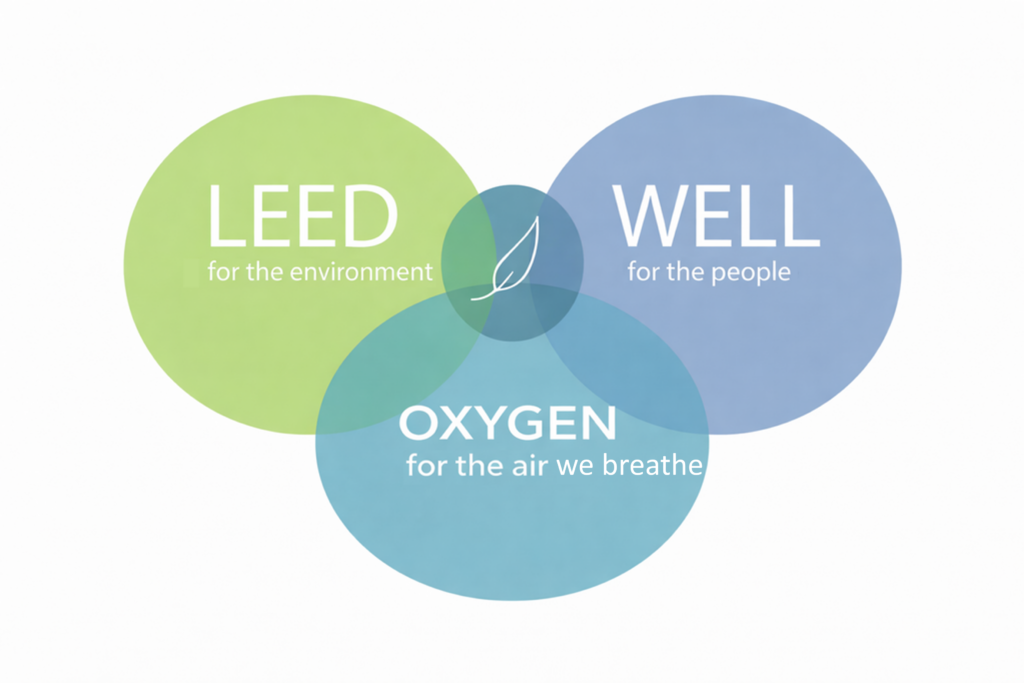
There’s something powerful about seeing LEED and WELL side by side. Both have become globally recognized signals that a building, or a company, cares about sustainability and human well-being. They’ve shaped how developers think, how architects design, and how brands position themselves in a competitive market.
But let’s be honest about something most people in the industry won’t say out loud: both LEED and WELL are, at their core, frameworks. They are standards, scoring systems, and certifications. They guide behavior. They reward best practices. And yes, they absolutely serve as differentiation tools in marketing.
That’s not a bad thing, it’s actually necessary. Standards create direction. They move industries forward. They give companies a language to communicate responsibility.
But they don’t do the work themselves.
A LEED-certified building can still have poor indoor air quality if execution falls short. A WELL-certified space can check boxes without necessarily solving the invisible, ongoing problem of airborne contaminants. Certification does not equal continuous protection. It signals intent and compliance, but not always real-time impact.
That’s where Oxygen changes the conversation.
Oxygen isn’t a framework. It’s not a checklist. It’s not a scorecard.
It’s a functional, embedded solution.
It lives inside the walls. It works continuously. It directly interacts with air at the surface level—where people actually breathe, live, work, and recover. Instead of guiding behavior, it delivers an outcome: cleaner indoor air.
That distinction matters more than most people realize.
Because when you zoom out, the real problem isn’t whether a building is certified. The real problem is whether the air inside that building is actively contributing to health—or quietly working against it.
This is the gap.
LEED focuses heavily on environmental efficiency, energy, materials, sustainability. WELL focuses on human experience, light, comfort, wellness. Both are essential. But neither is fundamentally built around a passive, always-on air purification layer embedded into the structure itself.
And that’s exactly what Oxygen brings to the table.
If LEED is “for the environment” and WELL is “for the people,” Oxygen is “for the air”, the one element that connects both missions but often gets treated indirectly.
Here’s the opportunity, and it’s a big one.
Instead of operating as parallel systems, LEED and WELL could evolve by integrating real, measurable, continuous air purification solutions like Oxygen into their standards. Not as optional credits or add-ons, but as foundational components.
Why?
Because the next evolution of building standards isn’t about better documentation—it’s about better outcomes.
Imagine a LEED-certified building that doesn’t just reduce environmental impact but actively neutralizes airborne pollutants inside. Or a WELL-certified space that doesn’t just promote wellness in theory but continuously improves respiratory health in practice.
That’s a different level of value. That’s not marketing, that’s measurable impact.
And from a business perspective, it actually strengthens LEED and WELL rather than competing with them. It moves them from being signals of intent to platforms of performance.
Companies today are under pressure, not just to say the right things, but to prove them. Consumers, tenants, and investors are getting sharper. They’re asking: What does this actually do for me?
Oxygen answers that question directly.
It doesn’t replace LEED or WELL. It completes them.
And if these standards are serious about leading the future of healthy, sustainable buildings, then integrating real-world, embedded solutions isn’t optional, it’s inevitable.
Because at the end of the day, people don’t breathe certifications.
They breathe air, and that’s why we created the Oxygen SEAL.
Add the Oxygen SEAL … Show that you CARE