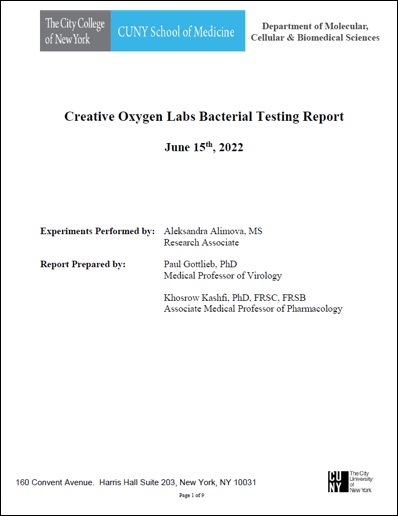
The City College of New York CUNY School of Medicine department of molecular, cellular, and biomedical sciences report affirms Oxygen’s anti-bacterial efficacy.
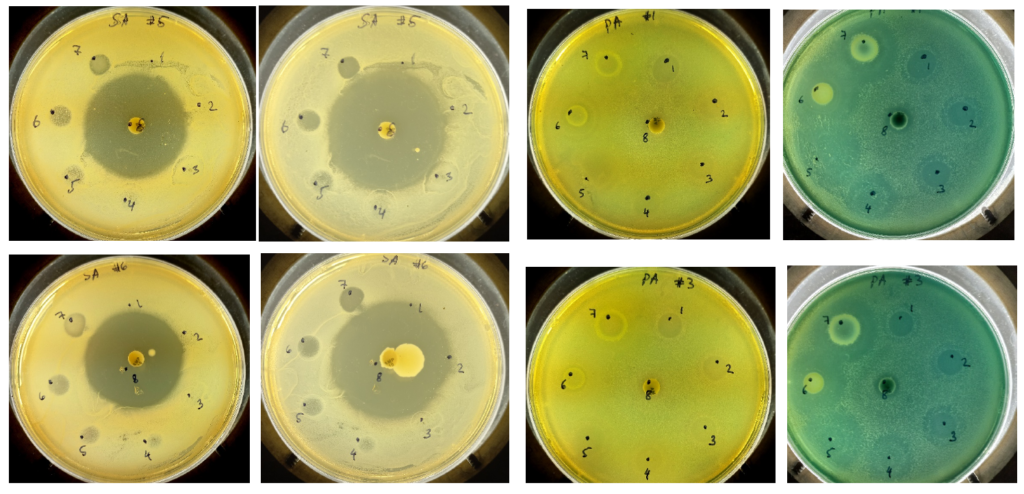
After 6 months of testing, CUNY School of Medicine, Dept. of Molecular, Cellular & Biomedical Sciences, issued its report on June 15th 2022, affirming that Oxygen additive, when applied to acrylic paint such as Benjamin Moore, Sherwin Williams and Premium Paints creates an anti-bacterial effectiveness against airborne and surface pathogens. Oxygens powder additive can eliminate airborne contaminants that have a direct impact on human health with 99% certainty.
The pathogens included Escherichia coli (E. coli, Gram-negative), Staphylococcus aureus (S. aureus, Gram-positive), Pseudomonas syringae (P. syringae, Gram-negative), Pseudomonas Aeruginosa (P. aeruginosa, Gram-negative).
All pathogens were cultivated under room and body temperature (37 degrees Celsius), and without the use of antibiotics, in order to simulate real world environment. The significance of these tests clearly show that Oxygen can be used as a defensive / protective shield to prevent the cultivation and spread of bacteria in any environment particularly in places where at risk people reside such as senior care centers, hospitals, and clinics, or places where there are large congregation of people such as building complexes, high-rises, restaurants, hotels and bars, airports, train stations etc.
Oxygens patent pending and US trademarked formula is made of natural minerals that are environmentally safe and can easily be dispersed into any acrylic paint without altering its color, texture, viscosity and composition. It can also last for as long as the paint remains on walls (over 10 years).
Technical Report: Antibacterial Efficacy of Creative Oxygen Labs’ Oxygen Paint Additive
1. Introduction
This report summarizes the methods and outcomes of independent laboratory evaluations confirming the antibacterial properties of Creative Oxygen Labs’ Oxygen paint additive when incorporated into standard interior acrylic paint. The findings focus on both gram‑positive and gram‑negative bacteria and the activation of antibacterial action once the paint has dried on a surface. The primary test referenced here was conducted under the auspices of The City College of New York, CUNY School of Medicine, Department of Molecular, Cellular & Biomedical Sciences.
2. Background
Oxygen is a proprietary additive composed of engineered mineral components (e.g., zinc oxide and silver‑based chemistries) that are mixed into conventional acrylic paint before application. In finished form, the coating creates a surface designed to deter microbial colonization and reduce viable bacterial populations without altering standard physical paint properties. Independent testing has employed ISO 22196 protocols, an internationally recognized method for evaluating antimicrobial activity on plastic and non‑porous surfaces.
3. Test Objective
The core objective of the referenced test was to determine whether Oxygen‑infused paint, after drying into a surface film, exhibits measurable antibacterial activity against representative gram‑positive and gram‑negative organisms under controlled laboratory conditions. Outcomes were assessed in terms of bacterial growth inhibition and kill rate in comparison with untreated paint surfaces.
4. Tested Microorganisms
In the CUNY study, researchers selected a set of human‑relevant bacterial strains to represent both classes of cell wall types:
4.1 Gram‑Positive Bacteria
- Staphylococcus aureus (S. aureus) – a spherical bacterium commonly associated with skin and respiratory infections.
4.2 Gram‑Negative Bacteria
- Escherichia coli (E. coli) – a rod‑shaped bacterium widely used as an indicator organism in antimicrobial studies.
- Pseudomonas syringae (P. syringae) – typically a plant‑associated pathogen included to show Gram‑negative response.
- Pseudomonas aeruginosa (P. aeruginosa) – an opportunistic pathogen of clinical relevance known for its robust resistance traits.
5. Methodology
5.1 Paint Preparation and Application
An appropriate quantity of Oxygen additive was thoroughly mixed into standard commercial acrylic paint (e.g., Benjamin Moore, Sherwin Williams) to create the test formulation. The mixture was applied to hard, non‑porous substrates in accordance with standard architectural finishing practices and allowed to dry fully prior to testing.
5.2 Bacterial Exposure Conditions
Each strain was cultured at both ambient and human body temperature (37 °C) to emulate real‑world colonization environments. No antibiotic agents were present to influence bacterial survival during the assay.
5.3 ISO 22196 Evaluation
The ISO 22196 antimicrobial testing protocol was followed to quantify bacterial reduction. This method involves applying a defined microbial inoculum to the test surface, incubating under controlled temperature and humidity, and then enumerating surviving bacteria over a defined period.
6. Results
Across the spectrum of tested bacteria, Oxygen‑treated surfaces demonstrated significant antibacterial activity:
- Bacterial counts on Oxygen‑infused surfaces showed statistically significant reductions compared with untreated control surfaces.
- The observed kill rate approached or exceeded 99 % reduction in viable bacteria within a 24‑hour interval after contact on the dried paint surface.
This effect was noted for both gram‑positive (S. aureus) and gram‑negative (E. coli, P. syringae, P. aeruginosa) organisms, indicating broad‑spectrum inhibitory capability under the specific test conditions.
7. Activation After Paint Drying
Unlike coatings requiring external activation (e.g., UV light or moisture beyond standard indoor conditions), the antibacterial performance of Oxygen is reported to be inherent to the dried surface film. Once the paint binder cures and the constituents are fixed within the matrix, surface contact with microorganisms is sufficient to trigger interaction with the active mineral components. These components are thought to exert their effect via contact‑mediated disruption of bacterial viability, consistent with both silver and zinc oxide’s known microbicidal behavior in surface coatings.
8. Results
The inclusion of Oxygen additive into interior paint creates a surface environment hostile to a range of bacteria commonly used in antimicrobial testing. The comparable response across gram‑positive and gram‑negative cell types suggests that the mechanism of action is not limited by the structural differences between these groups.
These findings support its use in settings where surface‑borne bacteria could pose a health concern, particularly on painted walls and ceilings that remain in place for extended periods without frequent disinfection.
9. Conclusion
Independent laboratory evaluation affirms that Oxygen additive, once applied and dried as part of an acrylic paint film, exhibits measurable antibacterial efficacy against a representative selection of gram‑positive and gram‑negative bacteria.